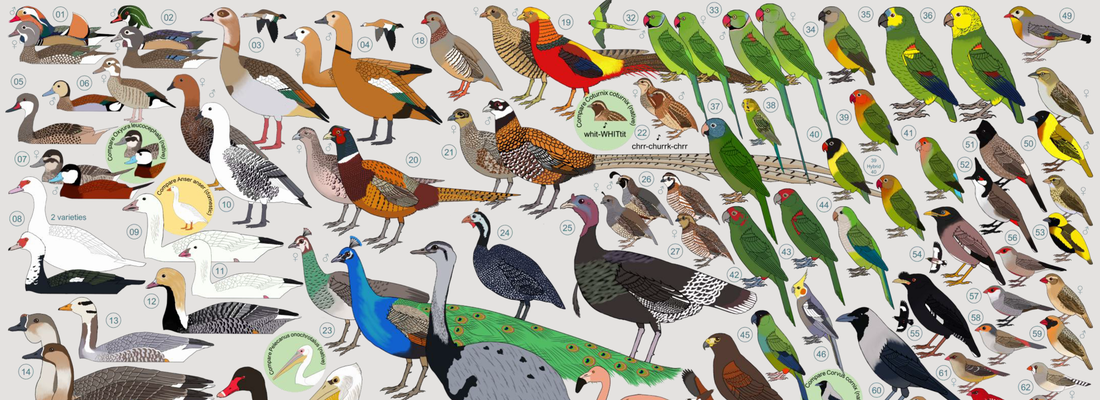
IBISurvey - Introduced Bird Interaction Survey
from 04/01/2021
The Introduced Bird Interaction Survey (IBISurvey) is a Citizen Science project developed by the University of Évora, Portugal, to improve knowledge about introduced bird species and their environmental, societal and economic impacts in Europe.
Throughout history, humans have intentionally or accidentally transported animals and plants beyond their natural geographic ranges. Some introduced bird species are able to survive and reproduce without continued human assistance, becoming established in their new environment. A smaller proportion may become invasive by increasing in abundance and spreading, potentially affecting native biodiversity, agriculture, human activities and economies.
IBISurvey focuses on introduced birds observed in wild conditions in Europe. The project invites citizens to report introduced birds and, particularly, their interactions with other animals, plants and humans. These observations provide information on species distribution, abundance, behaviour, habitat use, breeding activity and seasonal occurrence.
The project also addresses the challenge of identifying introduced birds, which may be unfamiliar to the public, restricted to particular regions, or confused with native species. IBISurvey provides species fact sheets containing identification information, ecological characteristics and updated information about establishment status across European countries and regions.
The project is a partner of the European Alien Species Information Network (EASIN), contributing citizen-generated observations to the broader understanding of introduced and potentially invasive species in Europe.
Aim
The main aim of the IBISurvey is to improve understanding of introduced bird species in Europe and assess their potential environmental, societal and economic impacts through citizen-generated observations.
Specifically, the project aims to:
1. Facilitate the identification of introduced bird species by providing accessible information and identification resources to the general public.
2. Collect information about the distribution and abundance of introduced birds across European countries and regions.
3. Document the behaviour and ecological interactions of introduced birds, including interactions with native animals, plants, agricultural crops and humans.
4. Improve knowledge of breeding and reproductive behaviour in introduced populations, helping researchers understand establishment and colonization processes.
5. Identify habitats, seasons and geographical areas in which introduced species occur and use these observations to improve knowledge of their ecology.
6. Increase public awareness of introduced and potentially invasive species and their possible impacts on biodiversity, agriculture, society and the economy.
7. Support scientific assessment of which introduced bird populations are becoming established or potentially invasive.
Citizen observations can provide information that would be difficult to obtain through conventional scientific surveys alone, particularly for species that are geographically widespread, locally abundant or occur in areas that are not regularly monitored.
How to participate
Anyone who observes an introduced bird living in wild conditions in Europe can contribute to IBISurvey.
To participate, observers should first identify the bird as accurately as possible. Participants can use the IBISurvey species fact sheets and identification information, which provide diagnostic characteristics, comparisons with similar species and information about the species' ecology and distribution.
Participants can then submit an observation of an introduced bird detected in the wild. The survey accepts observations of exotic bird species introduced to Europe, as well as European bird species that have been introduced into European countries or regions where they do not naturally occur.
When possible, participants are encouraged to provide information about the circumstances of the observation and the bird's behaviour. Particularly useful observations include:
- Feeding on crops, plants or other food resources
- Interactions with native birds or other animals
- Aggressive or territorial behaviour
- Breeding, nesting or reproductive behaviour
- Habitat in which the bird was observed
- Time of year or season
- Number of individuals observed
- Evidence of repeated occurrence or an established population
Photographs and other supporting information can also help with species identification and verification when available.
The project is intended for observations of birds living in wild conditions. Birds kept in captivity, such as birds inside zoo cages or enclosed areas, are not target observations.
Every observation can contribute to the project. Individual records help build a larger picture of where introduced birds occur, how they behave and whether populations may be establishing or spreading. By sharing observations, citizens help researchers improve assessments of introduced species and their potential environmental, societal and economic impacts.
Needed equipment
No specialised scientific equipment is required to participate in IBISurvey. The project is designed to allow members of the public to contribute observations using equipment that is commonly available.
A smartphone or digital camera is useful for photographing birds and documenting observations. Photographs can provide valuable evidence for species identification, particularly when introduced birds have unusual domestic or hybrid plumages or may be confused with similar native species.
A smartphone, tablet or computer with internet access is recommended for accessing the survey and species identification resources and for submitting observations.
Binoculars can be useful for observing birds from a safe and appropriate distance, particularly when the species is difficult to approach or identify by sight.
A field notebook or note-taking application may also be useful for recording details such as the date, time, location, number of individuals, habitat and observed behaviour.
Participants do not need professional birdwatching equipment or specialist scientific instruments. The most important resource is careful observation. Where possible, participants should record the species, location, date, number of birds and relevant behaviours or interactions.
Participants should avoid disturbing birds, nests or other wildlife while making observations and should follow applicable local regulations and access restrictions.
About funding
Funding bodies: FCT MED Mediterranean Institute for Agriculture Environment and Development
About branding
Card image by: Ana Sampaio
Banner by: Pedro Pereira
Logo design by: Ana Sampaio
Coordinator

Universidade de Évora
Academic
 Go to project website